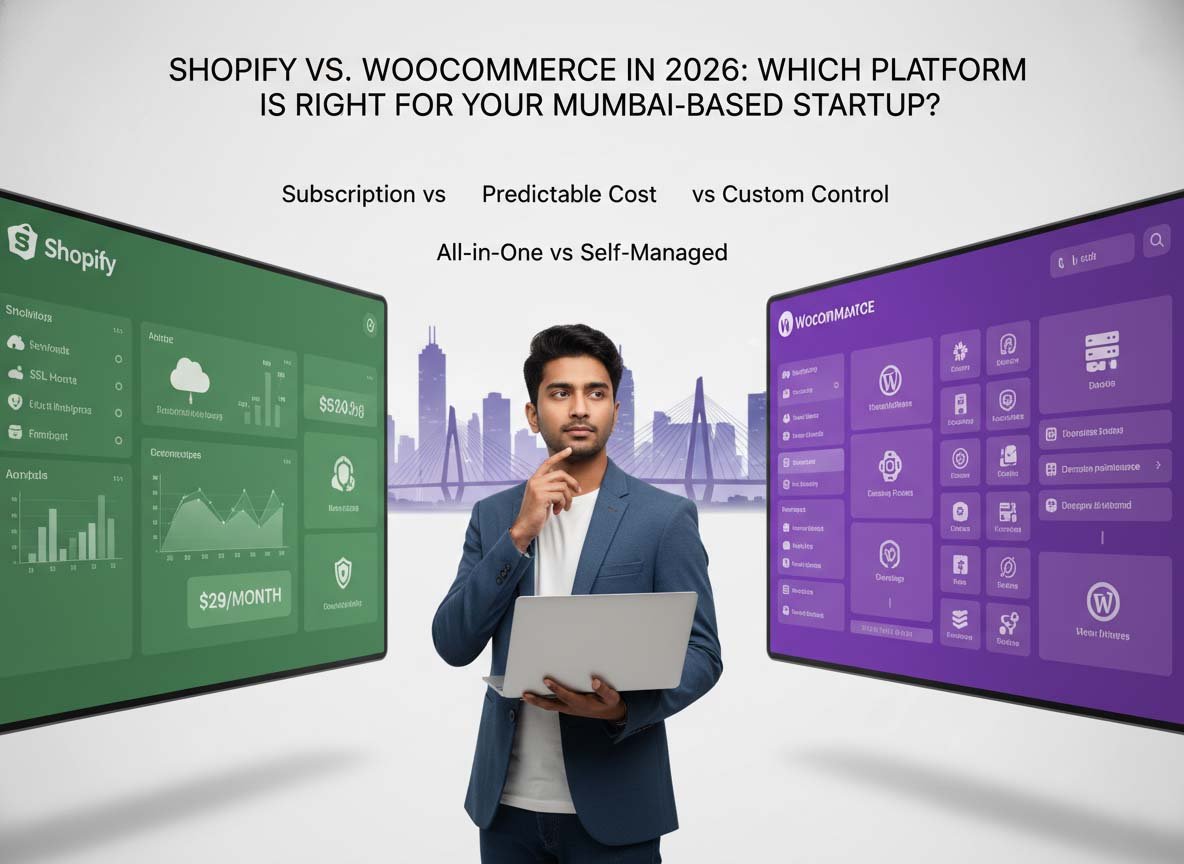
Shopify vs. WooCommerce in 2026
Shopify vs. WooCommerce in 2026
Shopify vs. WooCommerce in 2026
Shopify vs. WooCommerce in 2026
Shopify vs. WooCommerce in 2026

1. Pricing & Total Cost of Ownership
- Plans usually start from a monthly subscription (USD $29+), scaling to enterprise levels with Shopify Plus.
- Transaction fees apply unless you use Shopify Payments.
- Costs can add up with premium apps and advanced features.
- The core plugin is free, but you’ll pay for hosting, a domain, security, and essential plugins.
- Upfront setup can be cheaper initially, but maintenance, security, and developer time add ongoing costs.
- A high-performing store with many extensions and managed hosting easily falls in the same range (or higher) over time.
In practice: For a small store or early-stage Mumbai startup, WooCommerce can be cheaper initially if you already understand WordPress. But if you value predictability and minimal tech overhead, Shopify’s pricing is easier to budget.
2. Ease of Setup and Management
- Extremely beginner-friendly. You can launch a store in hours without technical skills.
- Everything-hosting, updates, backups-is managed by Shopify.
- Great for founders who want to focus on business, not servers.
- You first install WordPress, choose hosting, then add WooCommerce and essential plugins.
- Setup takes longer and requires more decisions (themes, caching, security, backups).
- Ongoing maintenance is generally on you or your tech partner.
Mumbai context: If your startup has limited technical talent, Shopify lets you get to market faster with less friction.
3. Customization & Flexibility
- As an open-source solution, you can modify everything-from product pages to checkout and backend logic.
- Best choice if your business requires unique workflows or heavy customisation.
- Offers a theme-driven design system with drag-and-drop blocks and 150+ themes.
- Custom code is possible, but system limits exist compared to a fully open ecosystem.
If unique user experiences are central to your brand or you plan ambitious site features, WooCommerce gives maximum flexibility.
4. Scalability & Performance
- Built for scaling: automatic performance handling and traffic spikes without you needing to manage servers.
- Ideal if you expect rapid growth or sporadic demand surges (e.g., flash sales).
- Can scale very well with the right hosting and optimisation stack (CDN, caching, database tuning).
- Requires hands-on tech expertise to match Shopify-like performance at scale.
Practical note: Shopify’s managed cloud removes infrastructure worries, while WooCommerce gives more control but mandates a better backend architecture.
5. SEO, Content & Marketing
- Since it lives on WordPress (the best blogging platform), it shines at SEO and content marketing.
- Plugins like Yoast or RankMath give granular SEO control.
- Has built-in SEO features and automates many technical tasks (sitemaps, canonical tags), but offers less deep control.
- Store speed (often faster) still helps SEO indirectly.
For content-driven strategies (blog series, organic traffic focus), WooCommerce might offer a slight edge.
6. AI & Automation in 2026
- Advanced integrated AI features for product descriptions, email campaigns, segmentation, and analytics.
- Saves hundreds of dollars monthly on third-party tools.
- AI integration exists via plugins but is fragmented and often adds extra cost.
If automation and content generation are core to your reduced-staff strategy, Shopify’s bundled AI is a big win.
7. Support & Ecosystem
- 24/7 support plus a mature app marketplace. Easier troubleshooting and fewer compatibility headaches.
- Rely on forums, developers, and plugin authors because official support is limited.
- Developer community is rich but decentralized.
For Mumbai founders without a dedicated technical team, Shopify support can be a big productivity booster.
What Works Best for Your Mumbai Startup?
- You want fast setup with minimal tech overhead.
- Your team is small or non-technical.
- You prioritise reliability, built-in AI, and support.
- You plan to scale quickly without managing servers or security.
Shopify is often the best all-around choice for founders aiming to focus on growth over infrastructure.
- You have access to developers or WordPress expertise.
- You want deep control and customisation.
- You plan to heavily leverage content marketing or SEO from day one.
- You want to optimise cost long-term and own every aspect of the store.
WooCommerce empowers unique experiences and flexibility where custom logic, SEO, and content matter.